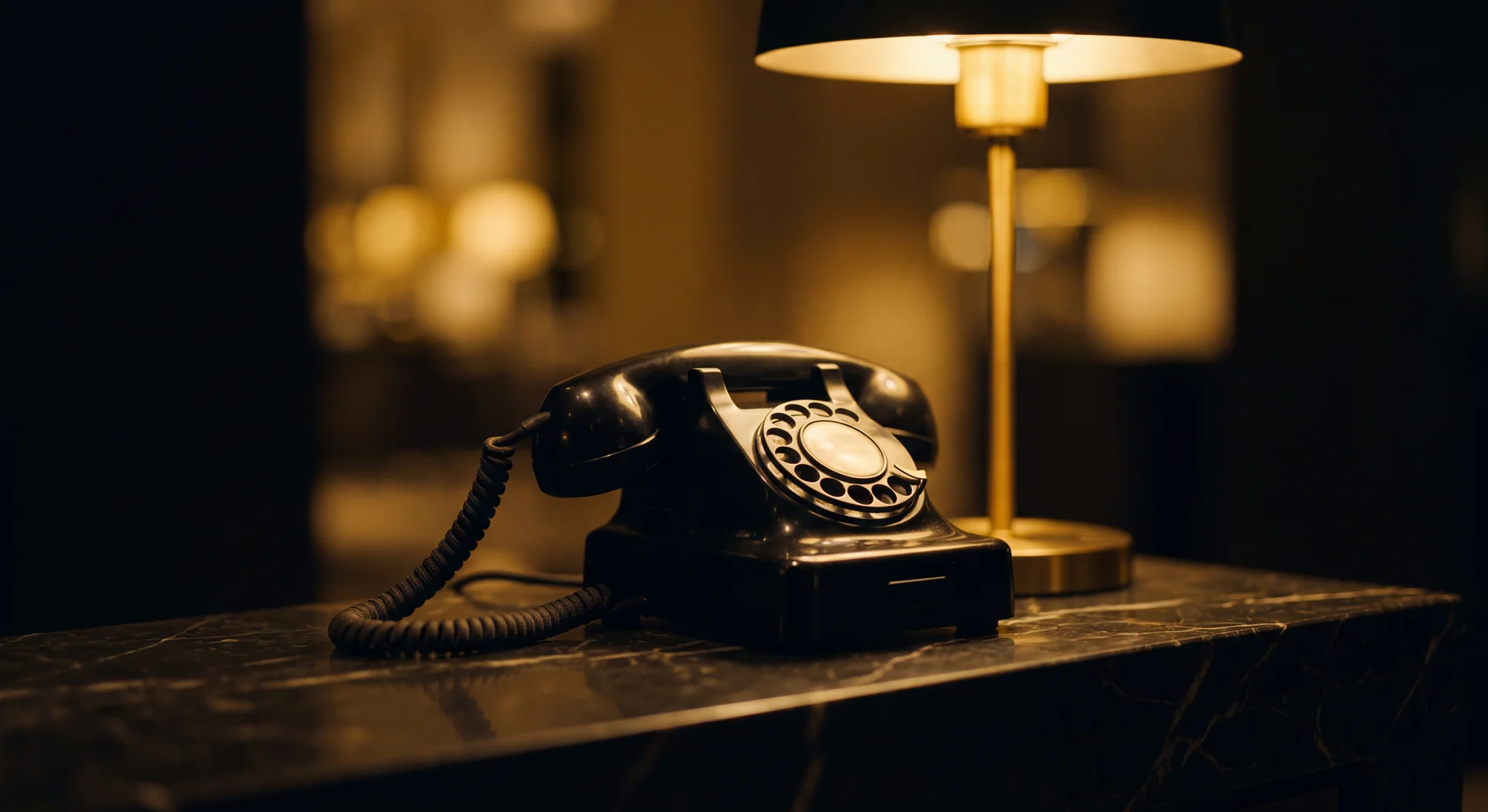
It is 8:47pm on a Tuesday in October. The evening receptionist just rolled a guest’s suitcase up to room 312 and has not come back down yet. The phone at the empty front desk is on its third ring. On the other end, a man with a voice that sounds like he is holding a credit card is asking his wife whether they take dogs. Ring four. Ring five. He hangs up.
By 9:02pm he is checking into a Marriott two blocks away, through Booking.com, which will keep roughly 18%.
This is the most common unmeasured loss in independent hospitality. And it is not a story about bad staff. It is a story about what happens when the single highest-intent funnel a hotel owns gets routed through a piece of furniture that only works when someone is standing next to it.
The numbers the industry pretends not to see
The most widely cited figure in this space is “up to 40% of hotel calls go unanswered.” It shows up on voice-AI vendor decks and LinkedIn posts. It is directionally correct. It is also not the sharpest number available, and the sharper one is worse.
StayNTouch, a hotel technology vendor that has actually measured it inside its installed base, reports that up to 62% of calls at independent properties go unanswered during peak hours, shift changes, and after-hours. That figure was reprinted in Hospitality.Today’s coverage of call abandonment.
How long does the average caller wait before they hang up? Talkdesk’s call-center benchmarks give the cleanest answer: over 50% of callers abandon after 90 seconds on hold. After voicemail, roughly 85% of callers do not leave a message, and of those, most never call back.
Against that leaky funnel, the same industry is dealing with a generational labor shortage. AHLA’s January 2025 survey of 282 hoteliers found 65% of hotels reporting staffing shortages, with 71% still holding unfilled openings, and front desk the second-most-shortage role behind housekeeping.
This is not a problem that shift scheduling fixes. There is no shift you can put Maria on at 8:47pm on a Tuesday that will also have her answering the fourth ring while she is upstairs with a bag.
What a hotel call is actually worth
The voice channel is not a routine service line. For a certain kind of property, it is the business.
Revinate’s 2024 Hospitality Benchmark Report, based on an analysis of 4.6 million guest calls, found two numbers that should be printed and taped to every GM’s monitor:
Inbound voice converts at approximately 50%. Voice drives 75–80% of revenue at independent 4- and 5-star properties.
Revinate, 2024 Hospitality Benchmark Report
Fifty percent. The digital booking funnel, across most independents, converts in the low-single digits. Voice, at that conversion rate, is an order of magnitude higher. It is the highest-intent channel the hotel has, by a wide margin, and it is precisely the channel that is being silently routed to voicemail.
Now layer in the distribution math from Kalibri Labs: a direct phone booking costs roughly $2.61 per occupied room to acquire. The same booking, closed by an OTA after the guest hangs up, costs $22.43, an 8.6x markup on the same room, on the same night, often from the same guest.
Every unanswered call is not just a lost conversation. It is a conversion that is going to happen anyway, being shifted from a channel that costs $2.61 to one that costs $22.43. At scale, across a year, that is the shape of the OTA tax every independent owner feels but struggles to name.
Call Capture Rate: the metric the industry is missing
Every GM watches RevPAR. Most track ADR, occupancy, GOPPAR, and channel mix. Very few track Call Capture Rate (CCR): the percentage of inbound guest calls that reach a human or AI capable of closing a booking, answering a pre-stay question, or handling an on-property request.
A property with a 90% CCR, against a 50% voice conversion baseline, and against Revinate’s finding that voice drives 75–80% of revenue at 4- and 5-star independents, will meaningfully outperform a property with a 50% CCR. The math compounds in a straight line: every 10 points of CCR recovered is some number of high-intent, direct bookings that would otherwise go to voicemail and revert to the OTA.
Here is what is striking: most hotels do not know their CCR. The PBX logs it, crudely. The PMS does not surface it. The RMS does not price around it. It is invisible to the financial reporting the GM sees every Monday morning. And invisible metrics do not get optimized.
Call Capture Rate belongs on the morning dashboard, next to RevPAR. Not because it is a cute vanity number, but because it is a first-derivative of the property’s relationship to the OTA tax. Improving CCR is the most direct operational lever a GM has to shift channel mix back toward direct.
Why the solution is not “hire more receptionists”
The labor math does not work. A 150-room independent at peak occupancy might take 40–120 inbound calls per day across every channel (direct dial, concierge line, spa, F&B, reservations). Staffing to cover every possible spike, 8:47pm Tuesday, 11:15am Sunday, 6:40am Thursday, would require a reservations-dedicated second shift that, at $20/hour fully loaded, runs roughly $40,000/year per headcount. Most independent P&Ls will not support it, and even if they did, the receptionist you hired yesterday has a 73% chance of leaving within the year per BLS leisure and hospitality turnover data.
The economics, the labor market, and the guest-experience expectations have diverged past the point where a purely human solution can close the gap.
The industry is already solving this, quietly
Skift, in its October 2025 coverage of AI adoption across hotel contact centers, notes that the major chains are already well into pilots with AI-powered call handling. Independents, typically, move later, not because they are less sophisticated but because they have historically had fewer vendors pricing for their scale.
That has changed. The voice-AI stack, built on the current generation of large language models and specialized conversation infrastructure, can now reliably:
- Answer every call on the first ring, in the guest’s language, 24 hours a day
- Pull the returning guest’s full stay history, preferences, and open reservations before the third ring
- Handle the routine 70% (wifi, directions, breakfast hours, late checkout) without escalation
- Escalate cleanly to a human for anything that requires judgment
- Close a direct booking on the phone, on the spot, without routing through a website
Against a 50% voice-conversion baseline, moving the CCR from 60% to 95% is not a marginal improvement. It is a material swing in the direct-booking channel mix, and it is one of the few operational levers an independent hotel can pull without a capital program.
The call at 8:47pm
Back to the dog question.
In the version of the story where the phone is answered on the first ring by a voice AI that knows the hotel takes dogs, knows the per-night pet fee, recognizes that the caller is a return guest from 2023 who stayed in a king pet-friendly, and offers him a direct booking for $188 instead of the $215 Expedia is showing, the hotel closes a direct booking. Net acquisition cost: under $3. The 8:47pm call becomes the 8:50pm reservation becomes the 10pm check-in.
In the version where the phone rings five times and goes to voicemail, everything that comes next is a rehearsal of the same outcome with an extra 20% shaved off. The guest still stays. The hotel still gets the room revenue. Booking.com gets $40.
That $40 is the tax. Five rings is the cost of not answering.
Call Capture Rate is how you stop paying it.